
Halal Collagen for Women Over 40: Skin, Hair & Nails

Collagen for women over 40 comes down to a simple question: what actually changes about your skin, hair, and nails after 40, and does supplementing really help? This guide covers the visible-aging science specifically, real clinical trials on skin hydration, wrinkle depth, and hair strength, and what to look for in a clean, halal certified source.
✅ DIRECT ANSWER
Collagen for women over 40 is best supported by real clinical evidence for skin hydration, elasticity, and wrinkle reduction, and there’s real trial data specifically in the 38-65 age range. A 2023 meta-analysis of 26 trials and 1,721 participants confirmed significant improvements in skin hydration and elasticity from hydrolyzed collagen. Daily use at 2.5g to 5g for 8-12 weeks is what the research supports. Shop Halal Collagen Bovine →
📋 KEY TAKEAWAYS
- A 2023 meta-analysis of 26 RCTs (1,721 participants) confirmed hydrolyzed collagen significantly improves skin hydration and elasticity.
- A 12-week trial specifically measuring skin, scalp, and hair together found a 44.6% decrease in dermal collagen fragmentation and a 27.6% increase in hair count.
- A trial specifically in women aged 38-50 found a 48% reduction in wrinkle depth and a 28% reduction in hair fall after 56 days.
- This guide covers visible aging specifically. If you’re navigating perimenopause or menopause symptoms, hormone decline changes collagen differently, see our dedicated guide: Collagen and Menopause.
📋 TABLE OF CONTENTS
What Actually Changes After 40
Collagen production declines gradually starting in your mid-20s, roughly 1% per year, and the visible effects compound over time.
Collagen makes up around 75% of your skin’s dry weight. As levels decline, skin loses its ability to hold moisture, fine lines deepen, and the firmness of younger skin gives way to a thinner texture. The same amino acids, glycine and proline, that support skin also provide the building blocks for keratin, the structural protein in hair and nails, which is why thinning hair and slower nail growth often show up around the same time.
This guide focuses specifically on that visible aging picture. If hormonal symptoms like joint pain, sleep disruption, or bone density are your primary concern, those are driven by a different, hormone-specific mechanism, covered in our dedicated guide: Collagen and Menopause.
The Skin Evidence: Hydration, Elasticity, Wrinkles
This is one of the most researched areas in collagen supplementation, and the evidence base is genuinely large.
A 2023 systematic review and meta-analysis of 26 randomized controlled trials, 1,721 participants total, found hydrolyzed collagen supplementation significantly improved skin hydration and elasticity. A separate randomized, placebo-controlled trial found 2.5g of collagen peptides daily significantly improved skin hydration, elasticity, roughness, and density over 12 weeks. (PubMed: 31627309)
A 2024 trial specifically measuring women 38-50 years old found 56 days of a collagen supplement produced a 48.11% reduction in wrinkle depth and a 15.69% improvement in skin hydration compared to placebo. (Clinical, Cosmetic and Investigational Dermatology, 2024)
⚡ QUICK ANSWER
Skin hydration and elasticity are the most consistently documented benefits of collagen supplementation, confirmed across a 26-trial meta-analysis and individual studies specifically in women 38-65. Effects are typically measurable within 8-12 weeks of daily use.
Hair and Nail Strength
Hair follicles sit in the collagen-rich dermal layer of skin, which is the structural link between skin aging and hair thinning.
A 12-week randomized, double-blind, placebo-controlled trial measured skin, scalp, and hair together and found a significant 44.6% decrease in dermal collagen fragmentation, alongside a 27.6% increase in total hair count and a 31.9% improvement in clinical hair-health grading. (PubMed: 39021368)
The same 2024 trial in women 38-50 found a 28% reduction in hair fall alongside the skin improvements noted above, suggesting the two effects move together when supplementation is consistent.
Why Collagen Type Matters
Not all collagen delivers the same structural support, and this matters specifically for skin, hair, and nails.
Type I collagen is the most abundant type in skin and is directly implicated in the hydration and elasticity studies above. Bovine collagen provides both Type I and Type III together, Type III supports the deeper skin structure and blood vessel network that keeps skin looking supported from underneath, not just hydrated on the surface.
Hydrolyzation matters just as much as the type. Collagen must be broken into smaller peptides to be absorbed, non-hydrolyzed collagen passes through largely intact and won’t produce the same results as the studies cited here, all of which used hydrolyzed collagen peptides.
Dose and Realistic Timeline
For skin and hair specifically, the effective dose is lower than you might expect, and consistency matters more than the exact number.
The research supporting skin benefits used doses as low as 2.5g daily. Skin hydration improvements are typically reported within 4-8 weeks. Hair and nail improvements generally take longer, 8-12 weeks in most trials, since hair growth cycles are slower than skin cell turnover.
Simply Halal’s Halal Collagen Bovine delivers 16g per serving, well above the dose used in the skin trials cited here, one scoop covers the effective range with room to spare.
What to Look for in a Clean Source
The studies cited above used clean, minimal formulations, not products loaded with fillers.
Hydrolyzed peptides, named clearly. The label should say “hydrolyzed collagen peptides,” not just “collagen.”
No maltodextrin. A common filler that adds nothing to the skin and hair benefits you’re paying for. Read: Side Effects of Maltodextrin
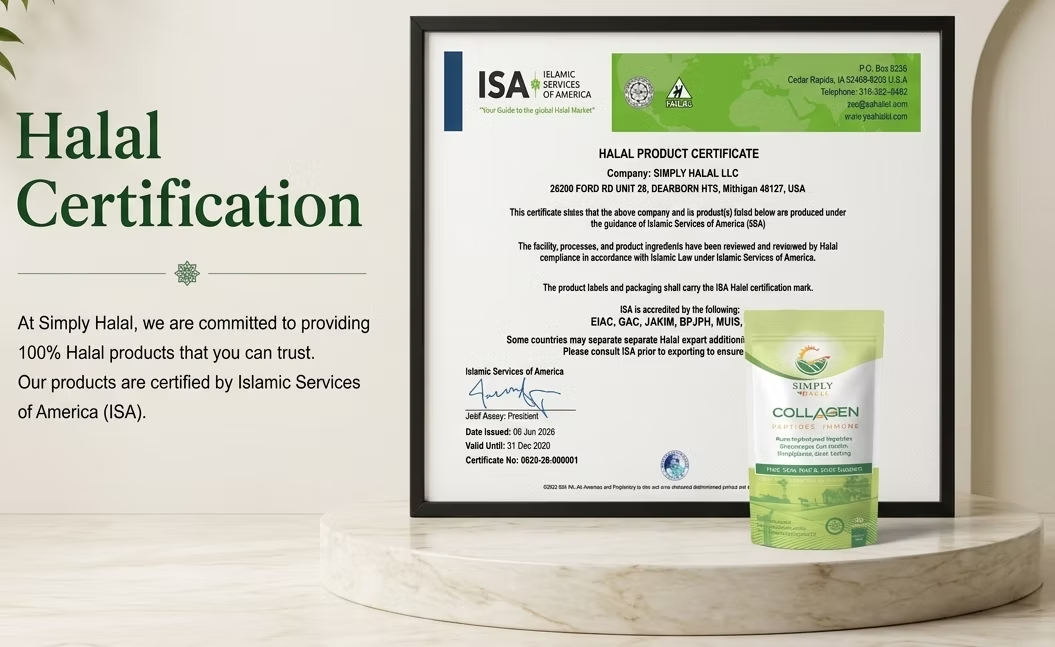
Named, verifiable halal certification. Confirms the animal source, processing facility, and ingredient integrity, not just a front-label claim. Read: Is Collagen Halal?
The Simply Halal Approach
Chef-crafted, not lab-formulated, with the sourcing transparency that matters when you’re taking something daily.
Chef Maher Fawaz spent three years researching and testing formulas, running 160+ lab tests, before a single product reached the market. The result is collagen sourced from grass-fed South American cattle, halal certified at every stage, with no shortcuts.
“
You are not paying for marketing. You are paying for 3 years of carefully researched product development, hand-picked ingredients chosen to maximize your nutritional benefit, and grass-fed sourcing that most supplement brands avoid because it cuts into their profit margins. Simply Halal was built for your health, not our bottom line.
Chef Maher Fawaz, Founder
✅ READY TO START?
Shop Halal Collagen Bovine → Check simplyhalal.co for current promotions and shipping offers, ships worldwide.
I Am Not Muslim. Does This Apply to Me?
Is halal certified collagen still right for me?
Yes. Halal certification is not a religious restriction on who may use the product. It provides independent verification that the product meets the halal requirements covered by the certifier’s review. The skin, hair, and nail science covered here applies the same way regardless of your background.
Frequently Asked Questions
Does collagen actually work for skin after 40?
Yes, this is one of the best-supported uses of collagen supplementation. A 2023 meta-analysis of 26 randomized trials and 1,721 participants confirmed significant improvements in skin hydration and elasticity from hydrolyzed collagen supplementation.
How much collagen should I take for skin and hair?
Research supports doses as low as 2.5g daily for skin benefits. Simply Halal delivers 16g per serving, well above this threshold. Consistency matters more than taking a higher dose occasionally.
How long until I see results in my skin or hair?
Skin hydration improvements are typically reported within 4-8 weeks of daily use. Hair and nail improvements generally take 8-12 weeks, since hair growth cycles are slower than skin cell turnover.
Is this different from collagen for menopause?
Yes. This guide focuses specifically on visible aging, skin, hair, and nails. If you’re navigating perimenopause or menopause, declining estrogen changes collagen through a different, hormone-specific mechanism affecting bone density, joint comfort, and sleep as well. See our dedicated guide: Collagen and Menopause.
What type of collagen is best for skin and hair?
Type I collagen is the primary type in skin structure. Bovine collagen provides Type I and Type III together, giving broader structural support than single-type sources. It must be hydrolyzed to be properly absorbed.
Where can I buy halal certified collagen for skin and hair in the USA?
Simply Halal offers halal certified collagen sourced from grass-fed cattle, available directly at simplyhalal.co. Ships worldwide.
You might also like
12 Aug 2026
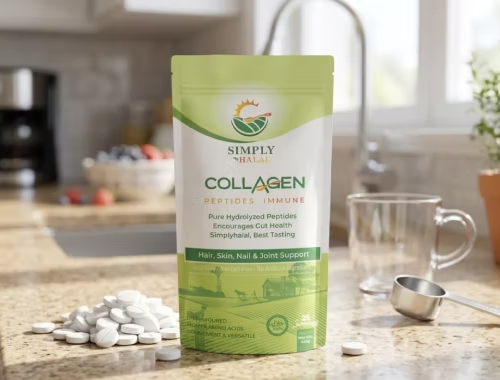
Halal Collagen Tablets vs Powder: Myth vs Truth
Are collagen tablets worth it? Rarely. A single scoop of collagen powder delivers more
1 Aug 2026
Is Bone Broth Halal? The Complete Answer
Is bone broth halal? Yes, but only when the bones come from an animal
25 Jul 2026
Why Simply Halal – The Chef-Crafted Halal Bone Broth Story
Most bone broth powders on the market start with the cheapest available raw material.
15 Jun 2026
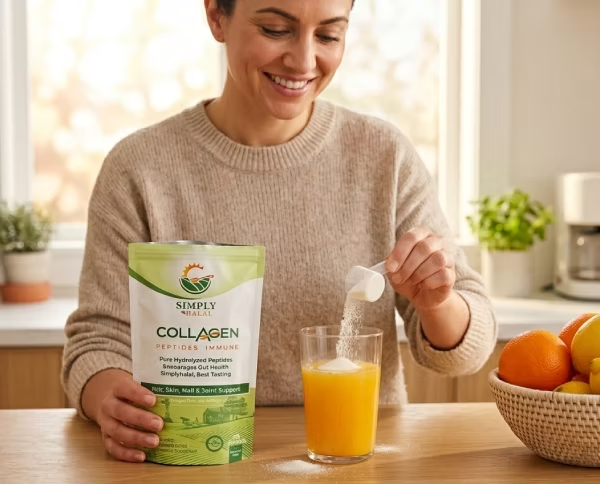
Vitamin C and Collagen: Why Most People Get It Wrong
Vitamin C and collagen have to work together, and most people get this wrong.
13 Jun 2026
Is Bovine Collagen Halal?
Is bovine collagen halal? Yes, it can be. But that answer only holds true
24 May 2026
Best Halal Bone Broth Powder for Athletes
Athletes put more stress on connective tissue than almost any other population. Every training
4 May 2026
Best Halal Bone Broth Powder for Skin
Skin health supplements are one of the most crowded categories in the wellness market.
3 May 2026
Best Halal Bone Broth Powder for Keto
If you are on a ketogenic or low-carb diet, bone broth powder is one
2 May 2026
Best Halal Bone Broth Powder for Joints
Joint pain is one of those problems that announces itself slowly. A knee that
2 May 2026
Best Halal Bone Broth Powder for Weight Loss
The bone broth and weight loss space is full of dramatic claims. Detox diets.