
Non-Halal Ingredients in Supplements: What to Check for
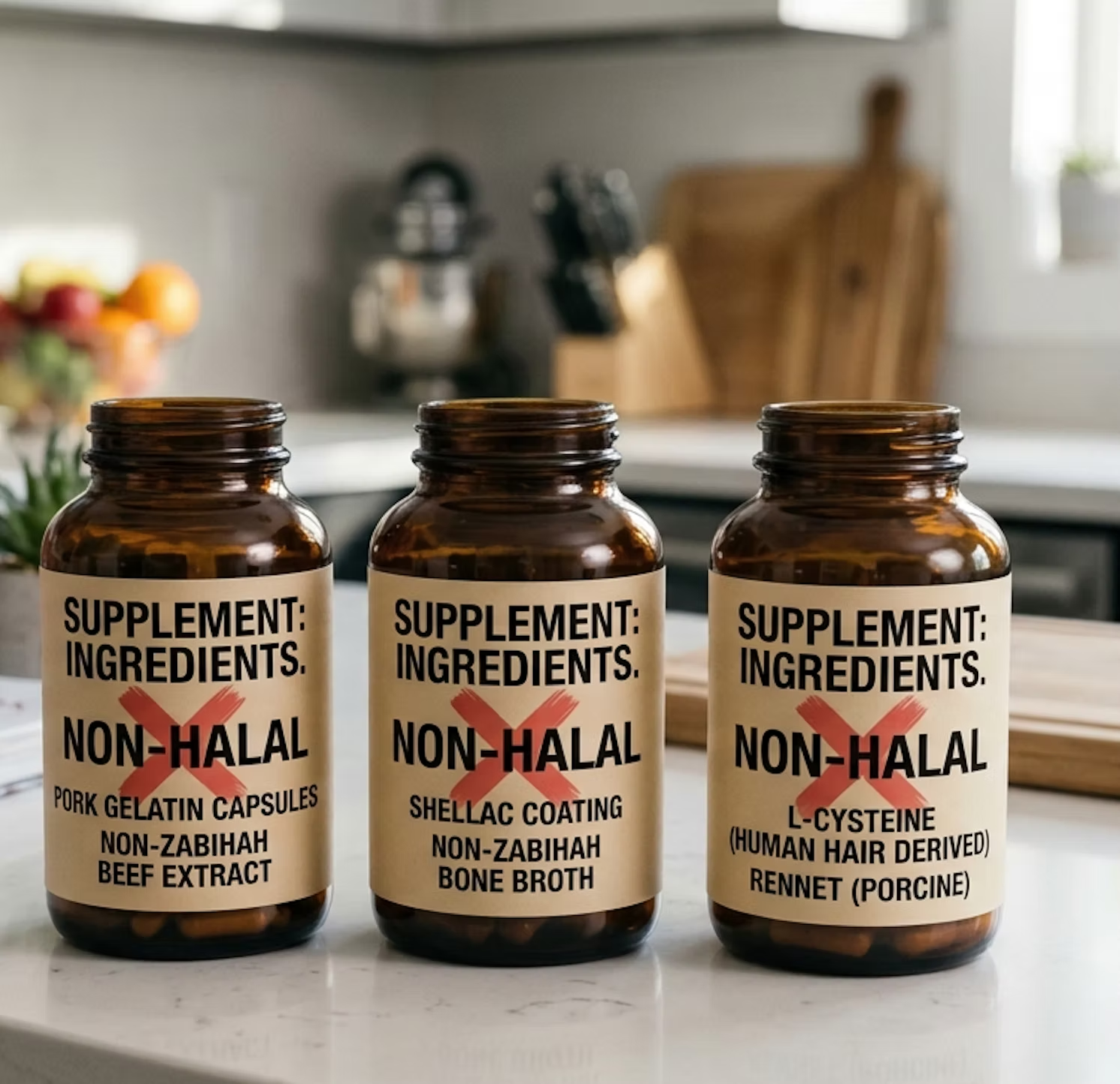
Most halal-conscious consumers know to avoid pork and alcohol in their food. But non-halal ingredients in supplements hide in places most people never think to check — in the capsule shell, in the tablet lubricant, in the flavoring system, and in the processing aids that never even make the front label. This guide gives you a complete, practical breakdown of every ingredient category that warrants scrutiny, the scientific names they hide behind, and exactly what to look for before you buy any supplement.
Note: Hydrolyzed collagen peptides — such as those in Simply Halal products — are a different substance entirely. Collagen peptides are enzymatically processed into small bioavailable amino acid chains and do not function as a gelling agent. Gelatin and collagen peptides share the same animal origin but undergo fundamentally different processing that produces completely different end products.
✅ Direct Answer
The most common non-halal ingredients in supplements are: gelatin from porcine sources in capsule shells, magnesium stearate from animal fat used as a tablet lubricant, natural flavors containing alcohol-based or maltodextrin carriers, glycerin from non-halal animal sources, and carmine (E120) from crushed insects used as a colorant. Many appear under scientific names designed to obscure their origin. The only reliable protection is third-party halal certification from a recognized body like ISA.
Why Non-Halal Ingredients in Supplements Are Hard to Spot on Labels
Food labeling regulations require manufacturers to disclose primary ingredients — but supplement manufacturing operates with significantly more flexibility around what gets disclosed and how. Inactive ingredients, processing aids, capsule materials, and flavoring carriers can all be present in a finished supplement without being clearly identified as to their source or origin.
A peer-reviewed study published in PMC examining halal compliance in pharmaceutical and supplement products found that common supplement ingredients including gelatin capsule shells, magnesium stearate, glycerin, and stearic acid can all be derived from porcine or non-halal animal sources — and the ingredient name alone provides no indication of which source was used. This means that a supplement listing “gelatin,” “magnesium stearate,” or “glycerin” on its label could be fully compliant or completely haram depending on the supply chain — and the label gives you no way to tell the difference.
This is the fundamental problem halal-conscious supplement consumers face. The solution is not avoiding all supplements — it is knowing exactly which ingredients require verification and what questions to ask. The checklist below covers every major category.
⚡ Quick Answer
Supplement labels list ingredient names but not ingredient sources. “Gelatin,” “magnesium stearate,” and “glycerin” can each be halal or haram depending entirely on where they came from — and the label will look identical either way. Source verification requires either direct manufacturer contact or third-party halal certification.
Non-Halal Ingredient #1 — Gelatin in Capsules and Coatings
Gelatin is the most widely encountered non-halal ingredient in supplements — and the most important to check. It is used to make the capsule shells of the majority of supplement capsules on the market, as a coating for gel tabs, and as a carrier in encapsulated ingredients like beta-carotene, vitamin D, and omega-3 softgels.
The critical fact: approximately 60% of commercial gelatin is derived from porcine (pig) skin, bones, and tendons. Another 35% comes from bovine sources — but bovine gelatin is only halal if the animal was slaughtered according to Zabiha standards. The remaining small percentage comes from fish or plant sources. When a supplement label simply lists “gelatin” with no source specification, the statistical probability is that it is porcine — and consuming it unknowingly is exactly the scenario halal certification is designed to prevent.
Gelatin hides under several names on supplement labels. Watch for: gelatin, hydrolyzed collagen, gelling agent, stabilizer, natural protein, E441. Any of these in the inactive ingredients or “other ingredients” section of a supplement facts panel warrants verification.
Safe alternatives to look for: Vegetable capsule, HPMC capsule (hydroxypropyl methylcellulose), plant-based capsule, pullulan capsule. These are all gelatin-free and halal-compatible.
✅ Direct Answer
If a capsule supplement lists “gelatin” without specifying the source — assume porcine until confirmed otherwise. Look for “vegetable capsule,” “HPMC,” or “plant-based capsule” as safe alternatives. Softgels and gel tabs require the same scrutiny — their shells are almost always gelatin-based.
Non-Halal Ingredient #2 — Magnesium Stearate and Stearates
Magnesium stearate is one of the most common inactive ingredients in tablet and capsule supplements — and one of the most commonly overlooked halal concerns. It is used as a lubricant in tablet manufacturing to prevent ingredients from sticking to machinery during the pressing process. It appears in the vast majority of tablet-form supplements.
Stearic acid — the component from which magnesium stearate is made — can be derived from animal tallow (the rendered fat of non-halal slaughtered cattle or pigs) or from vegetable sources like palm oil. The lower cost of animal-derived stearic acid has historically made it the default choice for many supplement manufacturers. When a label lists “magnesium stearate” with no further specification, the source is unknown.
The same concern applies to related ingredients: calcium stearate, sodium stearate, stearic acid, E570 — all of these are stearate compounds that may be animal or vegetable derived. “Vegetable grade” or “vegetable stearate” on a label is a positive signal, but without halal certification the supply chain remains unverified.
What to do: Contact the manufacturer and ask specifically: “Is your magnesium stearate derived from animal or vegetable sources?” A reputable brand will answer immediately. A brand that deflects or doesn’t know is a red flag.
⚡ Quick Answer
Magnesium stearate, calcium stearate, and stearic acid can all be animal or vegetable derived. The name alone tells you nothing. Ask the brand directly whether their stearates are vegetable-grade, or choose supplements with halal certification that verifies all inactive ingredients.
Non-Halal Ingredient #3 — Natural Flavors and Flavor Carriers
This is the category that catches the most health-conscious consumers off guard — including those who already check for gelatin and stearates. “Natural Flavors” is an FDA-sanctioned catch-all category that can legally include flavoring compounds from virtually any natural source. This includes animal-derived flavoring compounds, civet oil from civet cats, castoreum from beavers, and — most commonly in supplement powders — alcohol-based flavor extraction solvents.
Beyond the flavor compounds themselves, the carrier system matters enormously. When liquid flavoring is added to a powder supplement, it must be dried onto a carrier. Maltodextrin is the most common carrier used — meaning that “Natural Flavors” on a flavored supplement powder almost always signals the presence of maltodextrin, even when the product claims to be “clean label.” The maltodextrin carrier does not need to be separately disclosed under FDA incidental additive rules.
Research published in PMC documents that maltodextrin disrupts the gut microbiome, promotes pathogenic E. coli biofilm formation, and damages the intestinal mucus barrier — making it particularly counterproductive in supplements marketed for gut health or collagen support. For the full breakdown of why this matters, read our dedicated guide: Side Effects of Maltodextrin.
Simply Halal never uses Natural Flavors in any product. Every ingredient in our formulations is explicitly disclosed on the label. What you see is all that is there.
✅ Direct Answer
“Natural Flavors” on a supplement label can legally mean almost anything — including animal-derived compounds, alcohol-based extraction solvents, and maltodextrin carriers. If a flavored supplement doesn’t explicitly disclose every flavoring component, treat it as unverified. Unflavored supplements or those with full ingredient transparency are the safest choice.
Non-Halal Ingredient #4 — Glycerin and Glycerol
Glycerin (also called glycerol) is widely used in supplements as a capsule softener, humectant, and liquid base for tinctures and liquid supplements. Like stearates, glycerin can be derived from animal fat or plant sources — and the label will not tell you which.
Animal-derived glycerin is a by-product of the rendering process for tallow and lard. When derived from pigs or non-halal slaughtered animals, it is haram. When derived from vegetable oils (coconut, palm, or soy), it is halal-compatible. The ingredient will simply be listed as “glycerin” or “glycerol” regardless of origin.
Glycerin is particularly common in softgel capsules, liquid supplements, gummy vitamins, and topical products like creams and lotions that some Muslims also consider subject to halal standards. The same verification approach applies — contact the manufacturer or look for third-party halal certification.
Non-Halal Ingredient #5 — Carmine and Insect-Derived Colorants
Carmine — also listed as E120, cochineal, carminic acid, or natural red 4 — is a red pigment derived from crushed cochineal insects. It is used as a colorant in red, pink, and orange-colored supplements, capsules, gummies, and coatings. The halal status of insect-derived ingredients is debated across Islamic legal schools, with many scholars ruling it impermissible.
Carmine is particularly common in: red or pink capsule shells, gummy vitamins, flavored powder supplements with berry or fruit coloring, and coated tablets. It can appear under any of its alternative names — always check for E120, cochineal, or carminic acid if you are concerned about insect-derived ingredients.
Safe alternatives: Supplements using natural plant-based colorants (beetroot extract, turmeric, spirulina) or no colorants at all are the cleaner choice.
⚡ Quick Answer
Red, pink, or orange-colored supplements and capsules may contain carmine (E120) — an insect-derived colorant considered impermissible by many Islamic scholars. Check for E120, cochineal, carminic acid, or natural red 4 on the label.
Non-Halal Ingredient #6 — Alcohol-Based Solvents in Liquid Supplements
Liquid supplements, herbal tinctures, and liquid extracts frequently use ethyl alcohol (ethanol) as a solvent or preservative. While the final alcohol content in a finished product may be low, many Islamic scholars consider any intentionally added alcohol in a supplement to be impermissible — particularly when non-alcohol alternatives exist.
Alcohol-based ingredients to watch for in liquid supplements: ethanol, ethyl alcohol, isopropyl alcohol, denatured alcohol, alcohol extract. Some manufacturers use propylene glycol or vegetable glycerin as alcohol-free alternatives — these are generally considered halal-compatible.
This concern extends to vitamin D3 supplements. The majority of commercial vitamin D3 is derived from lanolin — oil extracted from sheep’s wool through a process involving solvent extraction. While sheep’s wool itself is generally considered permissible, the solvent processing warrants verification for consumers following strict halal standards.
The Master Checklist — Non-Halal Ingredients to Check in Every Supplement
| Ingredient | Also Listed As | Concern | Safe Alternative |
|---|---|---|---|
| Gelatin | E441, gelling agent, stabilizer, “gelatin” without source specified | ~60% commercial gelatin is porcine — used in capsule shells and coatings | HPMC, vegetable capsule, pullulan — or halal-certified bovine gelatin |
| Magnesium stearate | Stearic acid, calcium stearate, E570 | May be derived from animal tallow | Vegetable-grade stearate, rice flour |
| Natural Flavors | Natural flavoring, flavor, artificial flavor | May contain animal compounds, alcohol carriers, or maltodextrin | Fully disclosed ingredients, unflavored products |
| Glycerin / Glycerol | Glycerol, E422 | May be derived from animal fat rendering | Vegetable glycerin (explicitly stated) |
| Carmine | E120, cochineal, carminic acid, natural red 4 | Derived from crushed insects | Beetroot extract, turmeric, no colorant |
| Alcohol solvents | Ethanol, ethyl alcohol, alcohol extract | Used in liquid supplements and tinctures | Vegetable glycerin, propylene glycol |
| Mono & diglycerides | E471, glycerol monostearate | Emulsifiers — may be animal derived | Plant-derived emulsifiers, sunflower lecithin |
| Maltodextrin | Dextrin, glucose polymers (hidden in “Natural Flavors”) | Gut-disrupting filler; not haram but problematic | No carrier, fully disclosed ingredients |
✅ Direct Answer
he eight non-halal ingredients in supplements that require verification before you buy: gelatin, magnesium stearate, natural flavors, glycerin, carmine (E120), alcohol solvents, mono and diglycerides, and maltodextrin. None of these are always haram — but none are always halal either. Source verification or third-party certification is the only reliable way to know.
How to Protect Yourself From Non-Halal Ingredients in Supplements
The only reliable way to protect yourself from non-halal ingredients in supplements is third-party halal certification from a recognized body. Reading labels carefully is necessary but not sufficient. The problem is that even a diligent label reader cannot verify the supply chain behind an ingredient name. “Magnesium stearate” looks identical whether it came from pig fat or palm oil. “Gelatin” looks the same whether it is porcine or halal bovine. Without independent verification, you are relying entirely on the manufacturer’s integrity — which is not a standard any halal-conscious consumer should have to accept.
Third-party halal certification from a recognized body — such as the Islamic Services of America (ISA), IFANCA, or ISNA — requires audit and verification of every ingredient in a product, including all inactive ingredients, processing aids, capsule materials, and flavor carriers. It also requires verification of the manufacturing facility to ensure no cross-contamination with haram substances occurs during production.
A self-declared “halal” claim on packaging without a certification body logo is not independently verified and provides no meaningful assurance. The logo of a recognized certification body is what matters — and ISA is one of the most rigorous and widely recognized halal certifiers operating in the United States. To understand exactly what ISA certification verifies and why it matters for collagen specifically, read our guide: Is Collagen Halal? Your Complete Guide.
How Simply Halal Addresses Every One of These Concerns
Every concern on the checklist above was a deliberate design decision at Simply Halal — not an afterthought.
Our Halal Collagen Bovine is a powder product — which means no capsule shell, no gelatin, and no stearate lubricants from tablet manufacturing. What’s in the bag: hydrolyzed bovine collagen peptides. That is it. No Natural Flavors, no maltodextrin, no artificial colorants, no alcohol solvents. Every ingredient is explicitly listed because every ingredient is intentional and clean.
Our Halal Collagen Broth and Halal Beef Bone Broth are formulated with certified halal bovine collagen and organic herbs — ancient sea salt, organic garlic, organic turmeric, organic ginger. Every ingredient on the label is a real food ingredient with a clear source. No carriers, no processing aids, no hidden anything.
And every batch is ISA-certified — meaning the sourcing, processing, and ingredient integrity are independently audited and verified. Not self-declared. Not marketing language. Third-party verified. To understand the full sourcing philosophy behind every Simply Halal product, read Our Story. To explore the full product range, visit our shop or start with the Halal Wellness Bundle — free shipping on all bundles, shipped nationwide.
⚡ Quick Answer
Simply Halal products are powder-based — eliminating gelatin capsule and stearate concerns entirely. Zero Natural Flavors, zero maltodextrin, zero colorants. Every ingredient explicitly disclosed. Every batch ISA-certified. This is what it means to refuse to compromise.
Frequently Asked Questions — Non-Halal Ingredients in Supplements
What are the most common non-halal ingredients in supplements?
Gelatin from porcine sources in capsule shells, magnesium stearate from animal tallow used as a tablet lubricant, natural flavors containing alcohol-based or maltodextrin carriers, glycerin from non-halal animal fat, and carmine (E120) from crushed insects. All of these appear under names that don’t reveal their origin. Third-party halal certification is the only reliable verification method.
How do I know if a capsule is halal?
Look for “vegetable capsule,” “HPMC,” or “plant-based capsule” in the ingredients. If the label simply says “gelatin” with no source specified, assume it is porcine until confirmed by the manufacturer. The safest approach is supplements with ISA or recognized third-party halal certification — which verifies the capsule material along with every other ingredient.
Is magnesium stearate halal?
Only if it is derived from vegetable sources. Magnesium stearate can be made from animal tallow (haram) or palm oil (halal) — the label name is identical either way. Ask the manufacturer directly whether their magnesium stearate is vegetable-grade, or choose certified halal supplements that verify all inactive ingredients.
What does “Natural Flavors” hide in supplements?
Potentially animal-derived flavoring compounds, alcohol-based extraction solvents, and maltodextrin spray-drying carriers — none of which need to be separately disclosed. Simply Halal never uses Natural Flavors. Every ingredient in our products is fully disclosed on the label with no catch-all categories.
What is the safest way to verify a supplement is truly halal?
Third-party certification from a recognized body such as ISA, IFANCA, or ISNA. These organizations audit every ingredient including inactive ingredients, processing aids, and manufacturing facilities. A self-declared “halal” claim on packaging without a certification body logo provides no independent verification and should not be relied upon. For more on what ISA certification means in practice, read our guide: Is Collagen Halal?
You might also like

13 Apr 2026
Collagen and Menopause: 8 Ways It Supports Your Body
Collagen and menopause are more connected than most women realize. As estrogen declines during

11 Apr 2026
Halal Collagen: The Complete Trusted Guide for 2026
Halal Collagen: The Complete Guide (2026) Halal collagen is one of the fastest-growing searches

10 Apr 2026
Halal Bone Broth: The Powerful Story Behind Simply Halal
Simply Halal Is a Movement, Not a Lab-Created Halal Collagen Brand — Here’s the

8 Apr 2026
Collagen for Women Over 40: What the Science Actually Says
If you are a woman over 40, collagen for women over 40 is not
7 Apr 2026
Collagen Food Supplement vs Protein Powder: The Real Difference
If you have ever picked up a tub of protein powder and tried to
5 Apr 2026
Halal Collagen Hair Skin Nails — What the Science Says
Finding the best halal collagen for hair, skin, and nails requires more than picking
5 Apr 2026
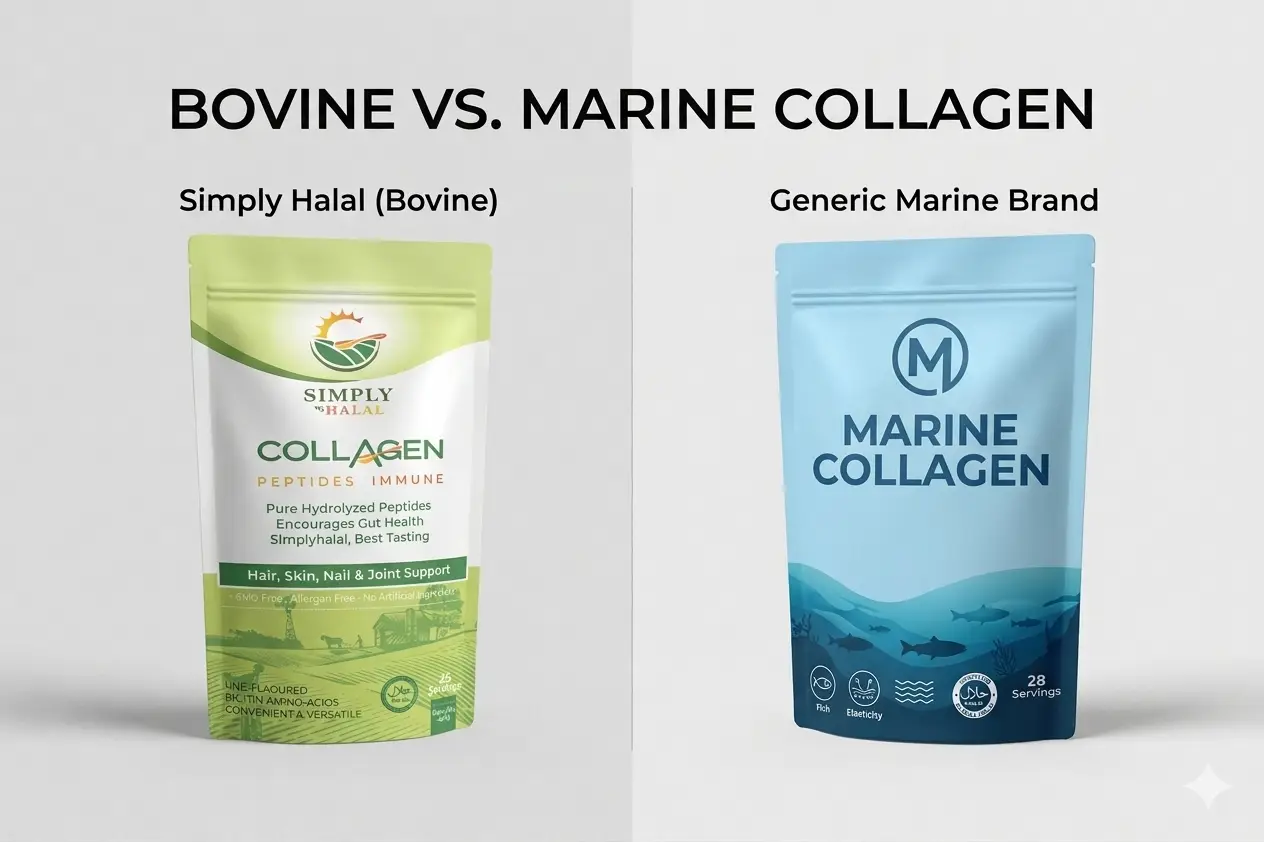
Bovine vs Marine Collagen: Which Is Better for Halal Diets?
The debate between bovine vs marine collagen matters more for halal-conscious consumers than for

2 Apr 2026
Halal Collagen Peptides: 7 Benefits for Skin, Hair & Joints
Collagen peptides have become one of the most researched supplements in health and wellness.
31 Jan 2026
Benefits of Protein: The Clean Living Guide for 2026
Understanding the full benefits of protein starts with source quality. The benefits of protein
27 Jan 2026
Healthy Snacks for Weight Loss — Protein-First Playbook
The best healthy snacks for weight loss have one thing in common — they