
Maltodextrin Side Effects: What the Science Actually Says

The side effects of maltodextrin are showing up in more health conversations in 2026 — and for good reason. This highly processed starch derivative is one of the most widely used food additives in the supplement industry, including in products marketed as “clean,” “natural,” and even “gut-healing.” If you’ve been taking a collagen powder, protein shake, or greens supplement and wondering why your gut still feels off, maltodextrin may be a significant part of the answer. This guide breaks down exactly what the science says — and why Simply Halal made the decision to remove it entirely from every product we make.
✅ Direct Answer
The main maltodextrin side effects are rapid blood sugar spikes (its glycemic index exceeds table sugar), disruption of the gut microbiome, damage to the intestinal mucus barrier, and promotion of harmful bacterial adhesion including E. coli strains linked to Crohn’s disease. It is particularly problematic when found in supplements marketed for gut health — including many collagen powders.
What Is Maltodextrin and Why Is It Everywhere?
Maltodextrin is a white, odorless powder produced by partially hydrolyzing starch — typically from corn, rice, potato, or wheat — using acids and enzymes. The result is a short-chain polysaccharide that is water-soluble, cheap to produce, and extremely versatile as a food additive. Despite being technically derived from starch, your body treats it almost identically to pure glucose: it is digested rapidly in the small intestine and absorbed directly into the bloodstream.
Food and supplement manufacturers use maltodextrin as a thickener, bulking agent, shelf-life extender, anti-caking agent, and — critically — as a spray-dried flavor carrier. This last use is how it ends up in products that don’t list it on the label at all. When liquid flavoring is added to a powder supplement, it has to be “dried” onto something. Maltodextrin is the cheapest carrier for that process. The resulting “flavored maltodextrin” is then classified as an incidental additive under FDA rules, meaning it can be listed simply as “Natural Flavors” without disclosing the carrier.
⚡ Quick Answer
If your collagen or protein powder lists “Natural Flavors” on the label, there is a very high probability it contains maltodextrin as the flavor carrier — it just doesn’t have to say so. This is the most common way maltodextrin hides in supplements marketed as clean.
Maltodextrin Side Effect #1 — Blood Sugar Spikes Higher Than Table Sugar
The most immediately measurable maltodextrin side effect is its impact on blood glucose. Despite being classified as a complex carbohydrate, maltodextrin behaves metabolically like a fast sugar. Its glycemic index ranges from approximately 85 to 136 depending on the source — compared to table sugar at 65 and pure glucose at 100.
This is not a theoretical concern. Research published in PMC confirms that the enzymatic digestion of maltodextrin occurs at a rate comparable to pure glucose absorption, producing equivalent postprandial insulin responses. In practical terms, this means consuming maltodextrin in a “sugar-free” supplement produces the same blood sugar spike and insulin demand as consuming actual sugar — often without the consumer being aware it’s happening.
For people managing diabetes, insulin resistance, PCOS, or metabolic syndrome, this is a significant concern. But even for healthy individuals, repeated blood sugar spikes from a daily supplement undermine the metabolic stability that clean nutrition is supposed to support. If your collagen powder contains maltodextrin, you are unknowingly adding a high-glycemic load to your morning routine every single day.
✅ Direct Answer
Maltodextrin has a higher glycemic index than table sugar and is absorbed as fast as pure glucose. Taking it daily in a “clean” supplement produces repeated blood sugar spikes — the opposite of what a metabolically conscious wellness routine should deliver.
Maltodextrin Side Effect #2 — Gut Microbiome Disruption
This is where the science becomes especially concerning — and especially relevant to anyone taking collagen for gut health. Multiple peer-reviewed studies have demonstrated that maltodextrin significantly disrupts the gut microbiome, with effects that go well beyond simple digestive discomfort.
A systematic review published in the European Journal of Nutrition analyzed 70 randomized controlled trials where maltodextrin was used as a placebo control, and found that 60% of those trials documented maltodextrin-induced physiological, microbial metabolite, or microbiome effects — meaning maltodextrin was not the inert placebo researchers assumed it to be. Documented changes included alterations in Firmicutes and Bacteroidetes phyla, and reductions in beneficial Lactobacillus and Bifidobacterium species.
In other words, maltodextrin actively reduces the beneficial bacteria that support your immune function, digestion, and mood. This is the opposite of what a supplement designed to support gut health should be doing.
⚡ Quick Answer
A systematic review of 70 clinical trials found maltodextrin altered the gut microbiome in the majority of studies — reducing beneficial bacteria and changing the microbial balance in ways that increase disease susceptibility. This was supposed to be the placebo. It wasn’t neutral at all.
Maltodextrin Side Effect #3 — Intestinal Mucus Barrier Damage
The intestinal mucus layer is your gut’s first line of defense. It separates the 38 trillion microorganisms living in your digestive tract from the epithelial cells lining your intestinal wall. When this mucus layer is compromised — a condition associated with “leaky gut” and inflammatory bowel disease — bacteria and toxins can penetrate the intestinal lining and trigger systemic inflammation.
Research published in Cellular and Molecular Gastroenterology and Hepatology found that maltodextrin consumption promoted endoplasmic reticulum stress in gut epithelial goblet cells, reducing mucin-2 production and depleting the protective mucus layer — with longer exposure producing low-grade intestinal inflammation even in otherwise healthy subjects. A separate study published in Frontiers in Immunology confirmed that maltodextrin decreased the number of mucus-producing goblet cells and increased microbial proximity to the intestinal epithelium.
This is the direct mechanism by which maltodextrin undermines gut health — and it is the exact reason that taking a collagen powder containing maltodextrin while trying to support gut barrier integrity is counterproductive. The collagen peptides work to support tight junctions and epithelial repair; the maltodextrin carrier is simultaneously depleting the mucus layer those tight junctions depend on.
✅ Direct Answer
Maltodextrin damages the intestinal mucus layer by reducing goblet cell mucin-2 production — the exact protective barrier that collagen is supposed to help maintain. Taking collagen with maltodextrin means working against your own gut health goals simultaneously.
Maltodextrin Side Effect #4 — Promotion of Harmful Bacterial Biofilms
Beyond disrupting the microbiome broadly, maltodextrin has a specific and well-documented relationship with one of the most clinically significant pathogenic bacteria in gut disease research. A study published in PLOS ONE demonstrated that maltodextrin markedly enhanced biofilm formation and intestinal epithelial cell adhesion of adherent-invasive E. coli (AIEC) — the bacterial strain consistently found in elevated levels in ileal Crohn’s disease patients. The mechanism involves maltodextrin metabolism by the bacteria, which upregulates genes associated with adhesion and biofilm construction.
A follow-up review published in PMC further documented that maltodextrin consumption impairs cellular anti-bacterial responses and deregulates intestinal anti-microbial defense mechanisms — making the gut lining more vulnerable to colonization by pathogenic bacteria, including Salmonella, in addition to AIEC strains.
The temporal correlation between rising maltodextrin consumption in the American diet and rising Crohn’s disease incidence is documented in the published research. This does not establish direct causation — but the biological mechanism by which maltodextrin creates conditions favorable to the bacteria implicated in Crohn’s is clearly established.
⚡ Quick Answer
Maltodextrin specifically promotes biofilm formation and intestinal adhesion by E. coli strains associated with Crohn’s disease. It also impairs your gut’s anti-microbial defenses — making it easier for harmful bacteria to colonize the intestinal wall.
The “Natural Flavors” Loophole — How Maltodextrin Hides in Clean Supplements
Understanding the side effects of maltodextrin is only half the picture. The other half is knowing how to find it — because the supplement industry has become very good at hiding it.
Here is how it works: when a supplement manufacturer wants to add vanilla, chocolate, or berry flavor to a powder, they purchase a spray-dried flavor powder from a flavor house. That flavor powder consists of the flavor compound — typically a tiny percentage of the total — spray-dried onto a carrier. Maltodextrin is by far the most common carrier used because it is the cheapest, most available, and most neutral-tasting option. The resulting “flavored maltodextrin” is then classified as an incidental additive under FDA regulations, which means the supplement company can list the entire thing as “Natural Flavors” on the label without disclosing the carrier separately.
This means a product can truthfully state it contains “no maltodextrin” if the maltodextrin is embedded in the natural flavors component — because technically, the maltodextrin was never added directly. It arrived as a component of the flavoring system. This is legal. It is also exactly the kind of label-reading trap that health-conscious consumers deserve to know about.
✅ Direct Answer
To find hidden maltodextrin: (1) look for “Natural Flavors” on any flavored supplement — this almost always means maltodextrin-based spray drying. (2) Email the brand and ask specifically whether their natural flavors use maltodextrin as a carrier. (3) Choose unflavored supplements whenever possible, or brands that explicitly disclose their flavoring systems.
Why Simply Halal Never Uses Maltodextrin
When Simply Halal was developing its product formulations, maltodextrin-based flavor carriers were the industry standard option presented by manufacturers. They are cheaper, easier to work with, and produce a more consistent flavor profile in finished powders. Choosing to reject them was a deliberate financial and ethical decision.
Our position is straightforward: a supplement that claims to support gut health while containing an ingredient documented to damage the gut’s mucus barrier and promote pathogenic bacterial adhesion is not a supplement we are willing to put our name on. Full stop. This is why every Simply Halal product — the Halal Collagen Bovine, the Halal Collagen Broth, and the Halal Beef Bone Broth — contains zero maltodextrin, zero artificial flavors, and zero hidden carriers of any kind.
What’s on the label is all that’s in the bag. That commitment is ISA halal certified and independently verified — not just a marketing claim. To understand the full sourcing and formulation philosophy behind our products, read Our Story.
For a complete comparison of what to look for in a clean halal collagen product — and what to avoid — see our buyer’s guide: Best Halal Collagen Powder 2026. And to understand the full benefits that a truly clean collagen delivers when it isn’t compromised by fillers, read our Halal Collagen Benefits guide and our Halal Collagen Peptides: 7 Benefits for Skin, Hair & Joints.
How to Avoid Maltodextrin Side Effects — A Practical Checklist
Avoiding maltodextrin in your supplement routine requires active label-reading, not passive trust. Here is a practical checklist:
- Choose unflavored where possible. Unflavored collagen and bone broth powders have no need for a flavor carrier. If a product has no added flavor, it almost certainly has no maltodextrin. Simply Halal’s unflavored collagen is exactly this — pure peptides, nothing else.
- Read past the front of the pack. “No artificial sweeteners,” “no added sugar,” and “clean label” claims on the front mean nothing if “Natural Flavors” appears on the ingredient list on the back.
- Ask the brand directly. Email or message the company and ask: “Does your natural flavor use maltodextrin as a spray-drying carrier?” A clean-label brand will answer immediately and transparently. A brand that deflects or doesn’t know is a red flag.
- Watch for “dextrin” and “glucose polymers.” These are alternative names for the same class of compound. Any of these on a supplement label warrants the same scrutiny as maltodextrin itself.
- Check your bone broth too. Powdered bone broth is particularly susceptible to maltodextrin-based spray drying because the original liquid broth needs to be dried onto something. Many commercial bone broth powders use maltodextrin as the drying base. Simply Halal’s Halal Beef Bone Broth does not.
For recipe ideas that make clean, filler-free halal collagen easy to incorporate into every meal, visit our recipes page. And for the full daily routine built around clean collagen without compromise, see our Halal Collagen Daily Routine 2026 guide.
Frequently Asked Questions — Maltodextrin Side Effects
What are the main side effects of maltodextrin?
The main maltodextrin side effects are rapid blood sugar spikes (glycemic index higher than table sugar), disruption of the gut microbiome with reduction of beneficial bacteria, damage to the intestinal mucus barrier, and promotion of harmful E. coli biofilm formation linked to Crohn’s disease. These effects are particularly concerning when maltodextrin appears in supplements marketed for gut health or metabolic wellness.
Is maltodextrin in collagen powder harmful?
Yes — it directly undermines the gut health benefits you are trying to achieve. Research shows maltodextrin damages the intestinal mucus layer and promotes harmful bacterial adhesion — the exact tissues collagen peptides are meant to help repair. Simply Halal never uses maltodextrin in any product. For a clean alternative, see our Halal Collagen Bovine.
How do I know if my supplement contains maltodextrin?
Check for “maltodextrin,” “dextrin,” or “glucose polymers” on the ingredient list. More importantly, if the label lists “Natural Flavors,” the product almost certainly contains maltodextrin as a hidden spray-dried flavor carrier. Ask the brand directly whether their natural flavors use maltodextrin as a carrier — a transparent company will tell you immediately.
Does maltodextrin raise blood sugar?
Yes. Its glycemic index ranges from 85 to 136 depending on source — higher than table sugar at 65. Research confirms its absorption rate is equivalent to pure glucose, triggering rapid blood sugar spikes and insulin responses. This is particularly concerning for anyone managing diabetes, insulin resistance, or PCOS.
Why do collagen brands use maltodextrin if it’s harmful?
Cost. Maltodextrin is one of the cheapest spray-drying carriers available. It allows manufacturers to add flavoring while increasing product volume at minimal cost. Simply Halal rejected this approach entirely — which costs more to produce, and is the right thing to do. See our Our Story for why this decision was non-negotiable for us.
You might also like

13 Apr 2026
Collagen and Menopause: 8 Ways It Supports Your Body
Collagen and menopause are more connected than most women realize. As estrogen declines during

11 Apr 2026
Halal Collagen: The Complete Trusted Guide for 2026
Halal Collagen: The Complete Guide (2026) Halal collagen is one of the fastest-growing searches

10 Apr 2026
Halal Bone Broth: The Powerful Story Behind Simply Halal
Simply Halal Is a Movement, Not a Lab-Created Halal Collagen Brand — Here’s the

8 Apr 2026
Collagen for Women Over 40: What the Science Actually Says
If you are a woman over 40, collagen for women over 40 is not

7 Apr 2026
Collagen Food Supplement vs Protein Powder: The Real Difference
If you have ever picked up a tub of protein powder and tried to
7 Apr 2026
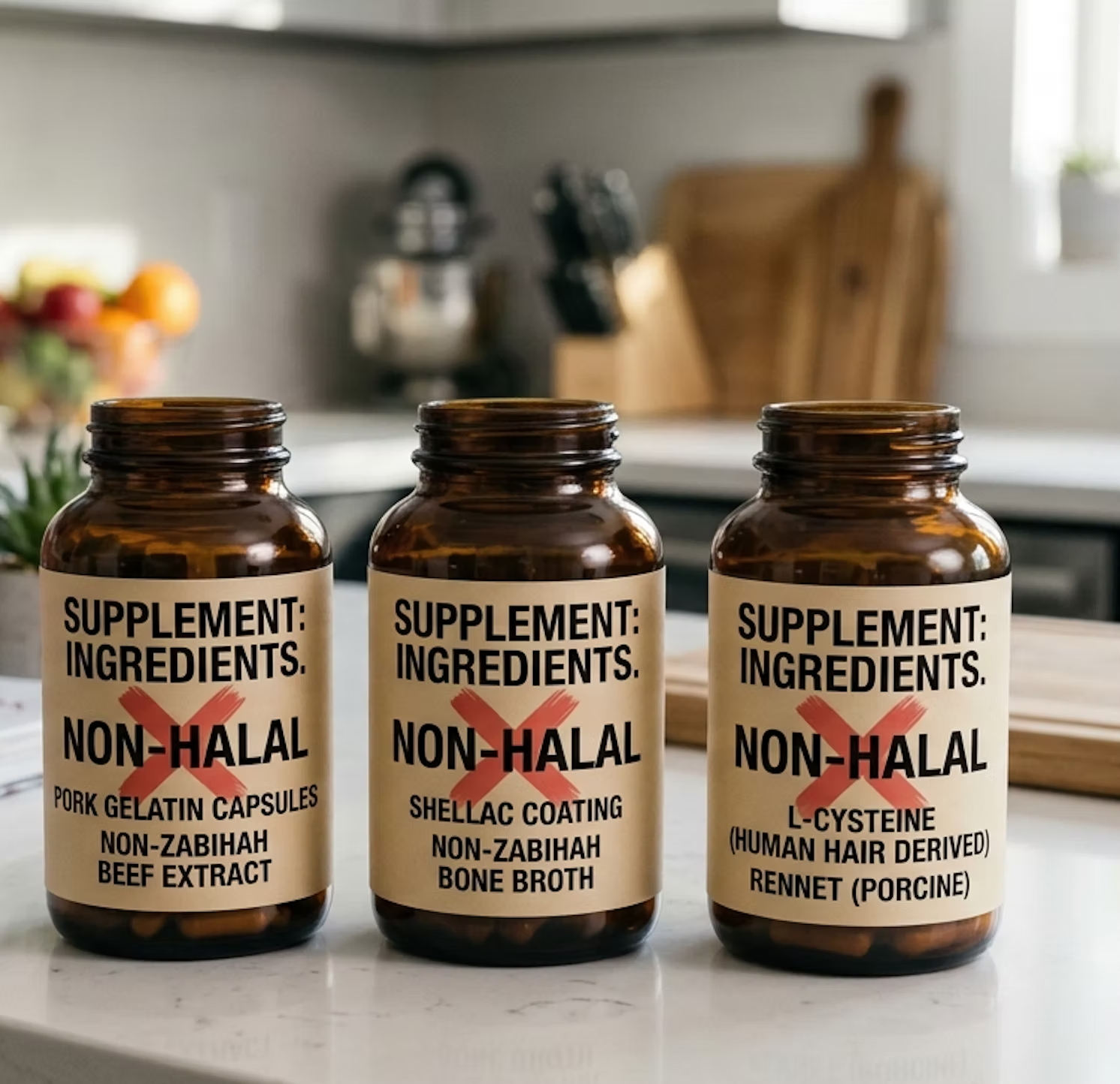
Non-Halal Ingredients in Supplements: What to Check for
Most halal-conscious consumers know to avoid pork and alcohol in their food. But non-halal

5 Apr 2026
Halal Collagen Hair Skin Nails — What the Science Says
Finding the best halal collagen for hair, skin, and nails requires more than picking
5 Apr 2026
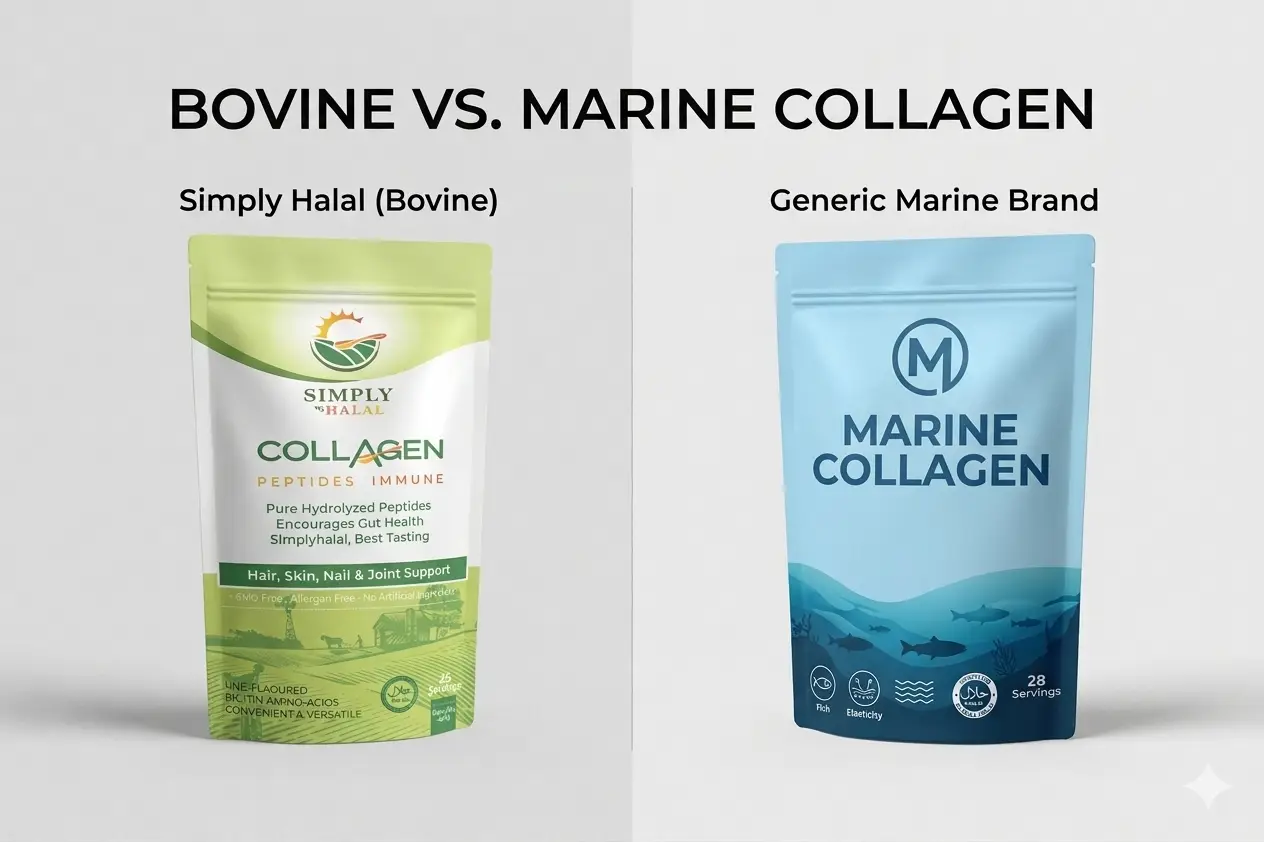
Bovine vs Marine Collagen: Which Is Better for Halal Diets?
The debate between bovine vs marine collagen matters more for halal-conscious consumers than for

2 Apr 2026
Halal Collagen Peptides: 7 Benefits for Skin, Hair & Joints
Collagen peptides have become one of the most researched supplements in health and wellness.
31 Jan 2026
Benefits of Protein: The Clean Living Guide for 2026
Understanding the full benefits of protein starts with source quality. The benefits of protein